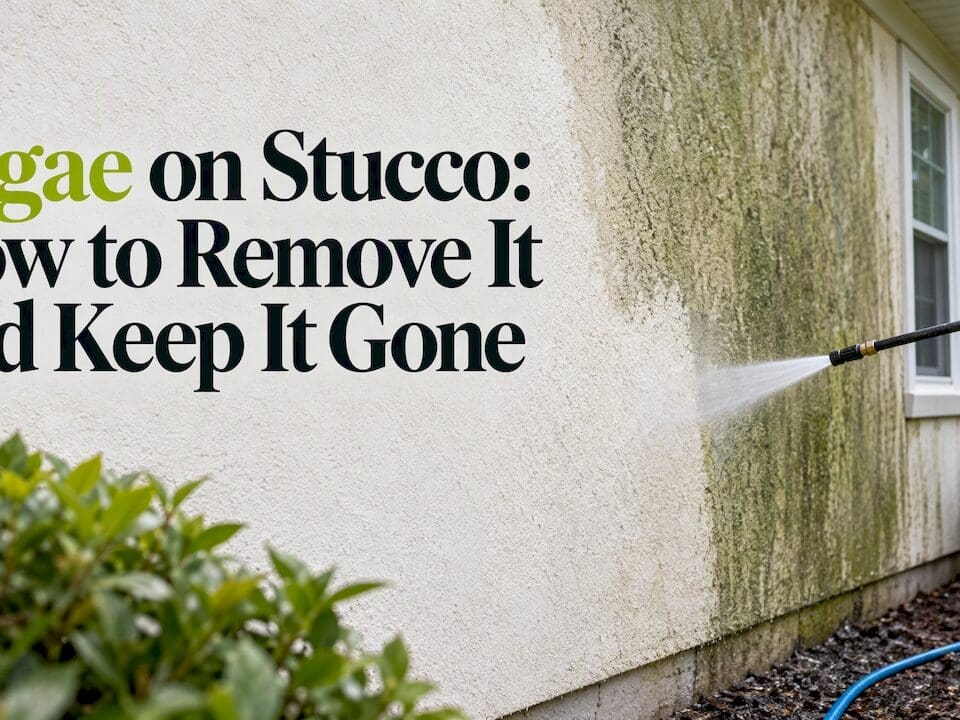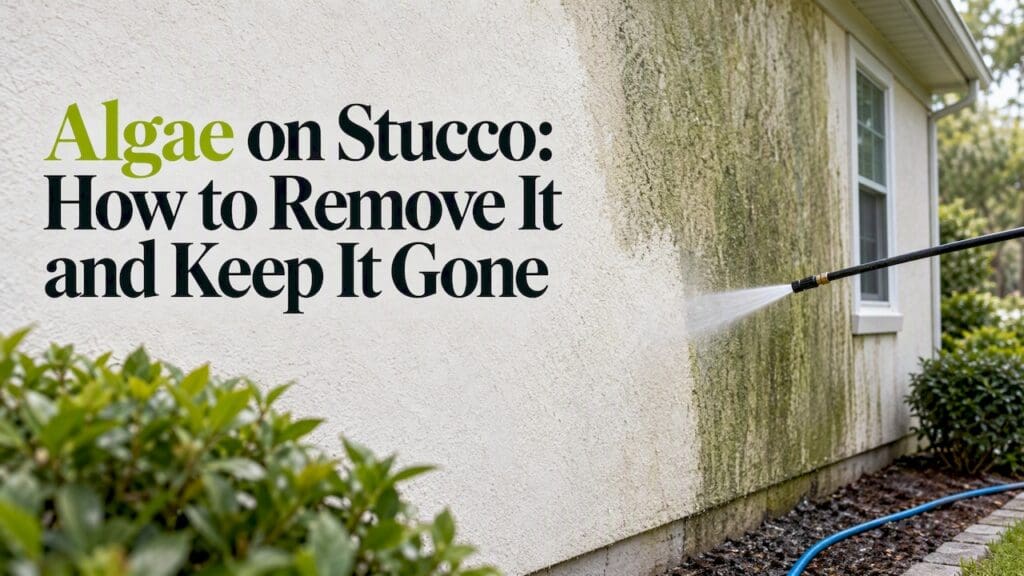
Green, gray or black streaks on stucco are almost always algae, and they come from moisture that never gets a chance to dry. You can remove them with a gentle, low-pressure wash and a bleach-based solution. They will return unless you fix the water and shade that feed them. Below you’ll find the safe method for painted stucco, what to avoid, how the same problem shows up as moss between pavers, and when it makes sense to hire a professional on Long Island.
TL;DR
- Algae on stucco is caused by persistent moisture, shade and poor drainage. Cleaning without fixing those conditions only buys you a season or two.
- For acrylic and acrylic elastomeric finishes, keep pressure at roughly 200 to 500 psi, use a soft-to-medium brush, and never use wire or stiff brushes or solvent-based cleaners.
- Test any method on a hidden patch first, and protect plants, windows and yourself before you touch bleach.
- Moss between pavers needs scraping, a gentle rinse and refilled joints, or it comes straight back.
- If the wall is two stories, delicate, or heavily covered, a soft wash by a licensed, insured crew is the lower-risk choice.
Table of Contents
- Why algae grows on stucco
- Is it algae, mildew, or something else?
- Before you clean: test, protect, gear up
- How to remove algae from stucco, step by step
- What not to do to your stucco
- Keep it from coming back
- The same problem on your patio: moss between pavers
- Perspective: what we see on Long Island properties
- When to call a professional
- How Cleanfellas handles stucco and pavers
- FAQ
- Sources
Why algae grows on stucco
Stucco is porous. It soaks up rain, dew and sprinkler overspray, and it releases that water slowly. Algae only needs a damp surface and a little light to settle in, and the film it forms holds even more moisture against the wall.
The National Park Service’s masonry cleaning guidance says algae and moss thrive where there is excessive moisture, shade and poor drainage. On Long Island homes, that translates into a few familiar spots:
- North-facing walls that never get direct sun.
- Walls behind dense hedges, arborvitae or overgrown trees.
- Areas under a leaking gutter or below a downspout that dumps water against the wall.
- Lower courses near the ground, where lawn sprinklers splash.
- Stucco near the Sound or bays, where humid air keeps surfaces damp for long stretches.
If the stains sit in one of those spots, you’ve probably found the cause as well as the symptom. Look at the stains before you buy any cleaner. A streak that starts below a roof corner points to a gutter or flashing problem. A uniform green band at the base points to sprinklers or soil contact.
Is it algae, mildew, or something else?
Green, brown or black film that smears slightly when wet is typically algae. Fuzzy gray or black spots in sheltered corners are often mildew. White, chalky deposits are usually efflorescence, which is a salt issue and not a biological one, and it needs a different treatment. One manufacturer notes that local rules on wastewater and cleaning chemicals should be checked before any cleaning project, which is worth remembering with efflorescence, since those procedures often involve different products.
Organisms and wall conditions vary, so a treatment that works on one house can fall flat on the next. A technical note from a masonry-care manufacturer says exactly that: what works in one situation may not work in another. Treat the first attempt as a trial, not a guarantee.
Before you clean: test, protect, gear up
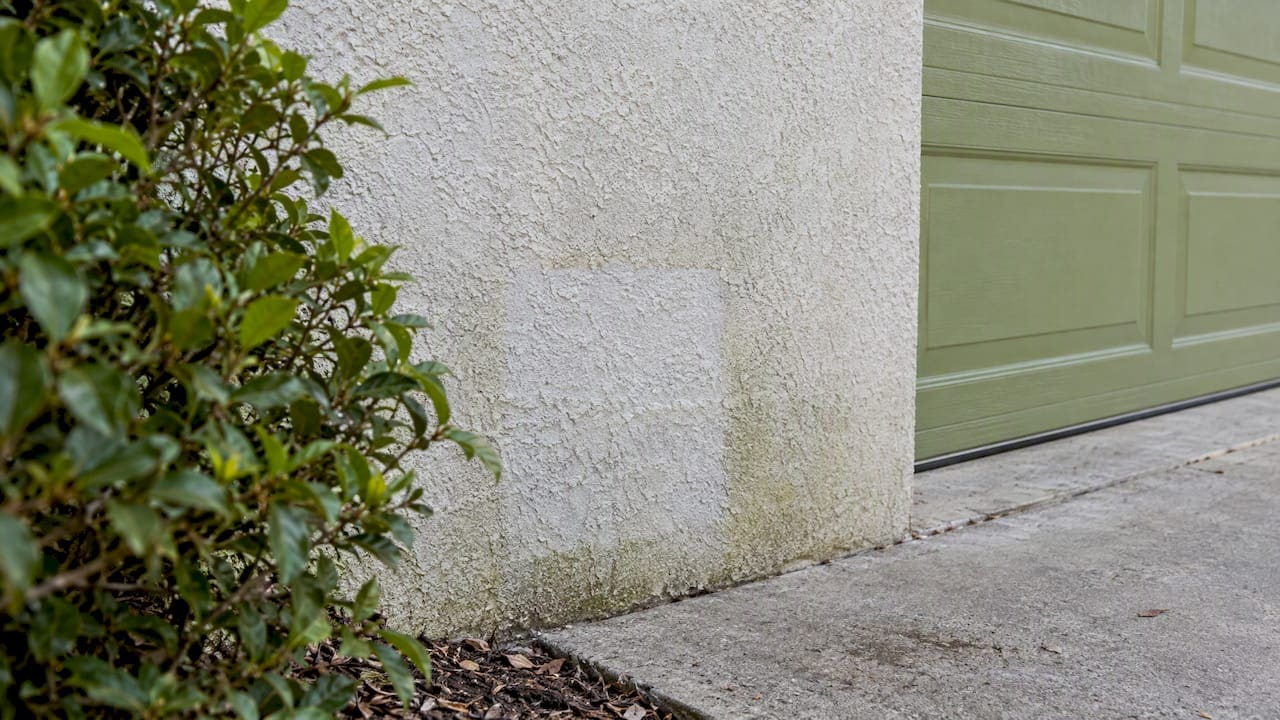
Test a hidden patch
Pick a low, inconspicuous spot, such as behind a shrub or beside the garage. The National Park Service recommends letting the test patch weather as long as possible: one year is preferred and one month is the minimum. Most homeowners won’t wait a year, but give it at least a few weeks to see whether the color changes or the finish dulls.
Go for the gentlest method that works
The same guidance says to use the gentlest means possible. It also says the goal should never be to make a wall look brand new if the cleaning risks speeding up deterioration. That’s a useful rule for stucco, which can be chipped, etched or driven full of water by a heavy hand.
Protect plants, windows and people
One EIFS and stucco cleaning specification calls for masking sensitive vegetation with tarps or polyethylene sheeting, keeping pedestrians away and making sure all windows are closed. Wet the plants with plain water first, cover them, and rinse them again afterward. Move pets and children indoors while you work and until surfaces are rinsed and dry.
Wear the right gear
The same specification calls for rubber gloves, safety goggles and protective clothing when you handle bleach or other chemicals. Long sleeves and closed shoes are part of that. Spray with the wind at your back, not toward your face.
How to remove algae from stucco, step by step
These steps follow the maintenance guidance a major stucco manufacturer publishes for acrylic and acrylic elastomeric finishes, which are common on newer and recently painted stucco. If your wall is traditional cement stucco, unpainted, or has an unknown coating, test first and consider a professional assessment.
- Wet the wall lightly. Use a garden hose or a pressure washer at the lowest setting. The goal is to dampen the surface and knock off loose dirt, not to blast it.
- Mix your solution. The manufacturer’s guide calls for 1 to 2 cups of TSP and ½ to 1 quart of bleach per gallon of warm water on acrylic finishes.
- Apply and let it soak. Work in manageable sections, from the bottom of the wall up so runoff doesn’t leave streaks on clean areas, and let the solution sit for 15 to 20 minutes. Don’t let it dry on the wall.
- Scrub only where needed. Use a soft-to-medium bristle brush on heavy deposits, with light pressure.
- Rinse thoroughly. Work from the top down this time. Leftover solution is how you end up with blotchy patches.
- Let it dry fully, then assess. Stains often look better or worse while wet. Judge the result when the wall is dry, and repeat only if you need to.
On heat and humidity, the same company’s specification adds a detail worth knowing: in hot, humid climates, TSP detergent should not be used without bleach, because TSP on its own is a food source for mold. On Long Island summers, that matters. If you use TSP, pair it with bleach as directed.
What not to do to your stucco
| Mistake | Why it hurts |
|---|---|
| Blasting with a high-pressure washer | For acrylic finishes, the manufacturer’s guide says not to exceed 500 psi. Higher pressure can strip the finish and push water behind it. |
| Using wire or stiff-bristle brushes | The same guide rules them out, along with solvent-based cleaners and high-temperature cleaning. They scratch and etch the surface. |
| Spraying upward at the wall | Water driven up under laps, trim and sealant joints gets behind the cladding. |
| Skipping the patch test | Cleaners can lighten or streak colored finishes. |
| Leaving bleach runoff on plants | Bleach burns foliage. Cover and rinse as described above. |
What about vinegar, Dawn and other home remedies?
Vinegar is a common suggestion, but it is acidic. The National Park Service guidance says acidic cleaners such as vinegar can damage certain types of masonry and should be avoided unless the manufacturer specifies them as safe for that substrate. Stucco is cement-based, so skip it.
The same source notes that bleach is often cited for algae but can be too harsh for delicate or historic surfaces. That’s why the patch test comes first. Dish soap on its own may lift surface dirt, but it won’t do much to the algae itself, and it’s no substitute for a proper treatment plan.
Keep it from coming back
Algae returns wherever moisture lingers. The park service’s guidance on prevention is practical: trim branches to increase light and redirect downspouts away from the surface. For your own wall, that comes down to a short checklist:
- Cut back shrubs and trees so air and sunlight reach the wall.
- Clean gutters and make sure downspouts discharge well away from the stucco.
- Adjust sprinkler heads so they don’t spray the wall.
- Keep soil, mulch and planting beds from touching the lower edge of the stucco.
- Fix any roof or flashing leak that sends water down the same streak every rain.
- Rewash on a schedule before the film gets heavy. Light growth is far easier to remove than a thick coating.
The same problem on your patio: moss between pavers
If you’re searching for algae on stucco, there’s a good chance moss between pavers is also bothering you. It’s the same cause: shade, moisture and a place to hold it. Joints that have lost their sand collect debris and stay wet, which is exactly what moss wants.
Removing moss from pavers and paver joints
- Scrape it out. A pavers care guide from a hardscape supplier suggests using a flathead screwdriver to scrape moss without scratching the pavers, then brushing away the loosened growth.
- Treat the surface. The same guide mentions a 50/50 bleach-and-water rinse, left for 15 to 20 minutes and then rinsed off. Another home-care guide suggests scrubbing with a stiff-bristle brush and water mixed with oxygenated bleach, then rinsing well.
- Rinse gently. Use a hose or a pressure washer on a low setting with a wide-angle nozzle. That guide cites a washer that delivers 1,500 psi as an example of a low setting for pavers. Aim sideways along the joints, not straight down into them, or you’ll blow out the sand.
- Let it dry, then refill the joints. Clean joints with no sand are an open invitation. Fresh polymeric sand locks pavers in place, resists washout and leaves less room for growth.
- Consider sealing. A sealer makes the surface easier to keep clean, though it works best on pavers that are already clean and dry.
As with stucco, shade and drainage decide how often moss returns. A patio under a maple will need attention more often than one in full sun.
Perspective: what we see on Long Island properties
We wash a lot of stucco, vinyl siding, pavers and patios across Nassau and Suffolk, and the pattern is consistent. Most of the damage we’re asked to fix isn’t from algae. It comes from the first cleaning attempt. A rented pressure washer, a stiff brush or an aggressive cleaner can scar a wall, and the scars show up long after the algae is gone.
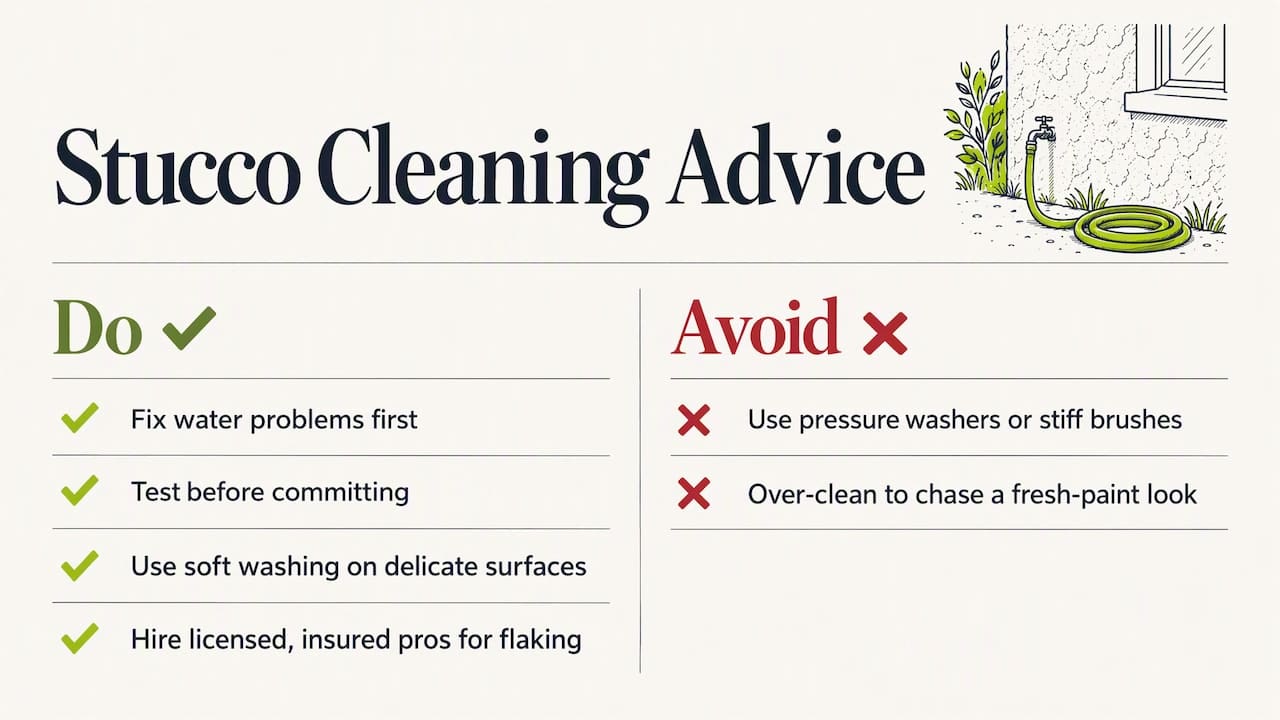
That’s why we lean on soft washing for delicate surfaces. Low pressure and well-chosen eco-friendly cleaning solutions lift the growth without chewing up the finish. We also think a clean wall should look clean, not new. Over-cleaning to chase a fresh-paint look is how finishes get worn thin.
Our advice is simple. Fix the water problem first, because a gutter or a sprinkler head will undo any wash. Test before you commit. And be honest about the height and condition of the wall: if you need a ladder to reach it or the finish is already flaking, hire someone licensed and insured to do it.
— the author
When to call a professional
DIY works for a small, low, painted wall in good condition. Bring in a pro when:
- The wall is above one story and you’d be working from a ladder with a wet brush and a chemical bucket.
- The stucco is unpainted, historic, cracked or already shedding paint, which makes it easy to damage.
- The growth is heavy or has returned right after you cleaned it.
- You don’t know what finish you have and can’t safely test.
- There are windows, landscaping or a pool nearby that you don’t want to expose to runoff.
- The job also includes pavers, decks, vinyl siding or fences, and you want one consistent result.
A professional also knows how to handle runoff. Local rules on disposing of wastewater and cleaning chemicals can apply, and they’re easy to overlook on a weekend project.
How Cleanfellas handles stucco and pavers
Cleanfellas is a Long Island power washing company, licensed and insured, serving homes and businesses in Nassau and Suffolk counties. We clean stucco, vinyl siding, decks, patios and fences, and we use soft washing and eco-friendly solutions on delicate surfaces so the finish stays intact while the algae comes off.
For moss on patios, our paver cleaning, restoration and joint sanding service removes the growth, then refills the joints with polymeric sand so it doesn’t take hold again. We also offer paver sealing. You can see everything we do on our services page.

If you want the wall and patio handled in one visit, contact Cleanfellas for a quote. If you’d rather keep growth from building up at all, ask about our maintenance plans. We also cover local areas such as Nassau County, Garden City and Port Washington.
FAQ
Will vinegar damage stucco?
It can. Acidic cleaners such as vinegar can harm some masonry, and guidance from the National Park Service says to avoid them unless the manufacturer lists them as safe for your substrate. Since stucco is cement-based, a bleach-based solution applied as directed for your finish is the better-documented choice, after a patch test.
What is the best way to remove algae from stucco?
For acrylic finishes, the manufacturer’s method is a low-pressure wet-down, a TSP and bleach solution left for 15 to 20 minutes, a light scrub with a soft-to-medium brush, and a thorough rinse. Keep pressure between about 200 and 500 psi. Test a hidden spot first, since different finishes react differently.
Will pressure washing alone remove stucco algae?
Usually not safely. Pressure strong enough to strip algae can damage the finish, and plain water doesn’t kill what’s growing. Soft washing, which combines low pressure with a cleaning solution, treats the growth and protects the surface.
How do I get rid of moss between pavers?
Scrape out the moss, treat the surface with a bleach solution as directed, rinse at low pressure with a wide-angle nozzle, and let everything dry. Then refill the joints with polymeric sand. Without fresh sand, the open joints collect debris and moisture, and the moss returns.
Why does algae keep coming back on my stucco?
Because the conditions that feed it are still there. Shade, trapped moisture, a downspout aimed at the wall or sprinkler overspray will bring algae back. Fix those first, then clean on a regular schedule.
Sources
- Stucco Repair and Maintenance, Sto Corp.
- Sto Specification RC100 reStore Cleaning
- Keeping It Clean: Removing Exterior Dirt, Paint, Stains and Graffiti from Historic Masonry Buildings, National Park Service
- Removing Biological Growth from Stone, Concrete, and Masonry, PROSOCO
- Removing Efflorescence in EIFS, Parex USA technical bulletin
- Guide Specification for General Cleaning of EIFS and Stucco, Total Wall
- Hardscape Care Guide, Western Interlock
- What to Do When Your Patio Is Overrun by Moss, Bob Vila